
Quick update: US labor force participation
A tight labor market, but volatile data

OK, we have the latest updates from the Bureau of Labor Statistics monthly labor survey. One note is that manufacturing employment is not growing, despite the Administration’s emphasis that tariffs would bring jobs home. In contrast, the share of healthcare continues to rise. The changes are small for the former, but consistent. Graph at bottom…
The real issue is whether the jobs numbers will support further interest rate reductions by the Federal Open Market Committee – I stress the FOMC because what happens is not under the unilateral control of the Chair of the Federal Reserve Board. Even though he was appointed by the President Trump during his first term, Jerome Powell will not be reappointed as he’s viewed as insufficiently subservient. His successor, however, will only have one vote.
So is the labor market weakening? If not, then additional rate cuts are more likely to be delayed. The expulsion of immigrants complicates the analysis; it suggests that the normal data are likely to understate tightness. I won’t venture there.
So two key points:
data remain volatile, which is not news to anyone who regularly works with labor force data, but is central to any discussion as it suggests caution
participation remains strong. so however “disappointing” job creation data may be, it’s not clear that there are additional workers to be had
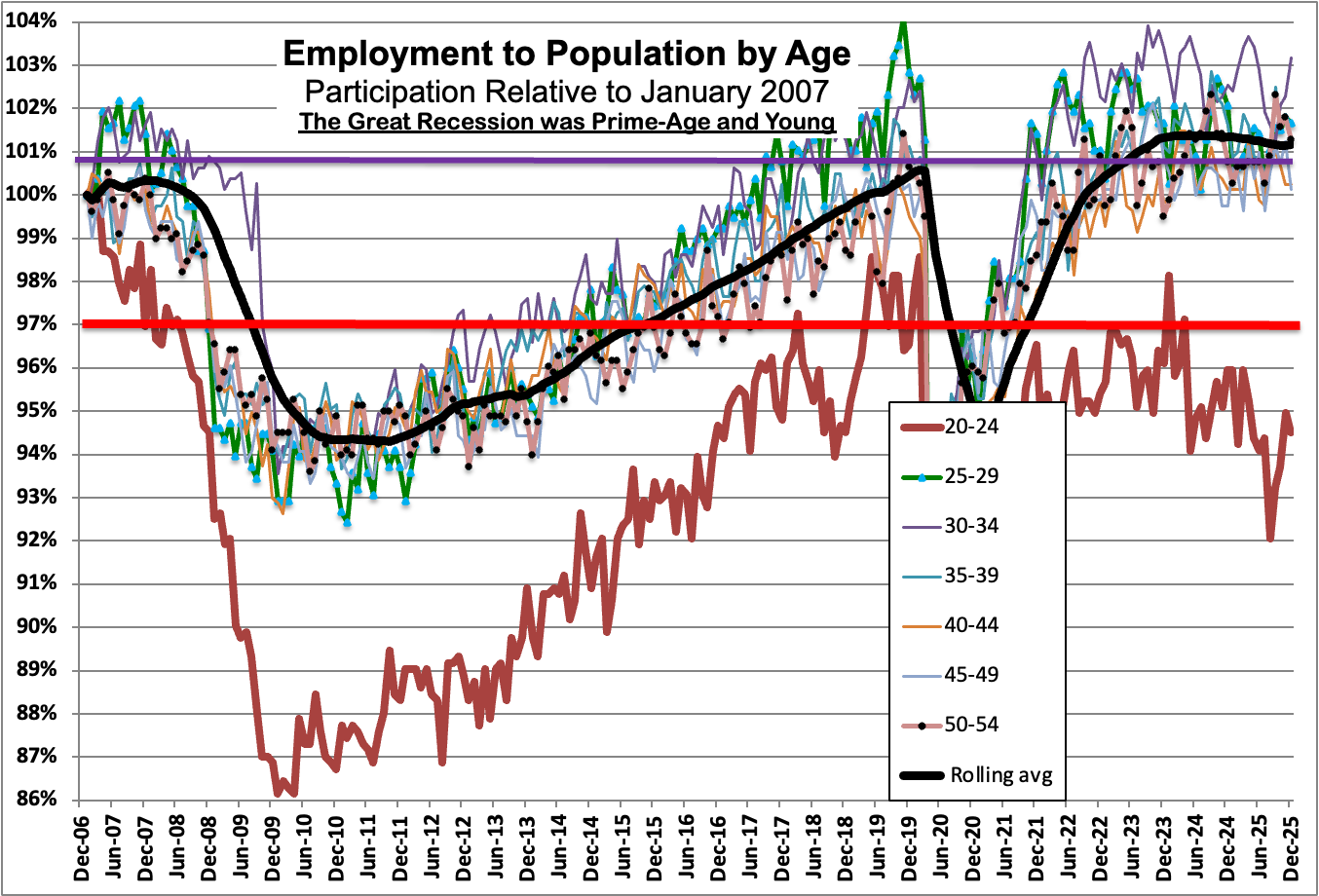
So looking at the data, younger workers – recent graduates, among others – continue to find the job market challenging. However, for the bulk of the labor force, participation is at a historic peak. We see that if we limit our perspective to prime-age workers.
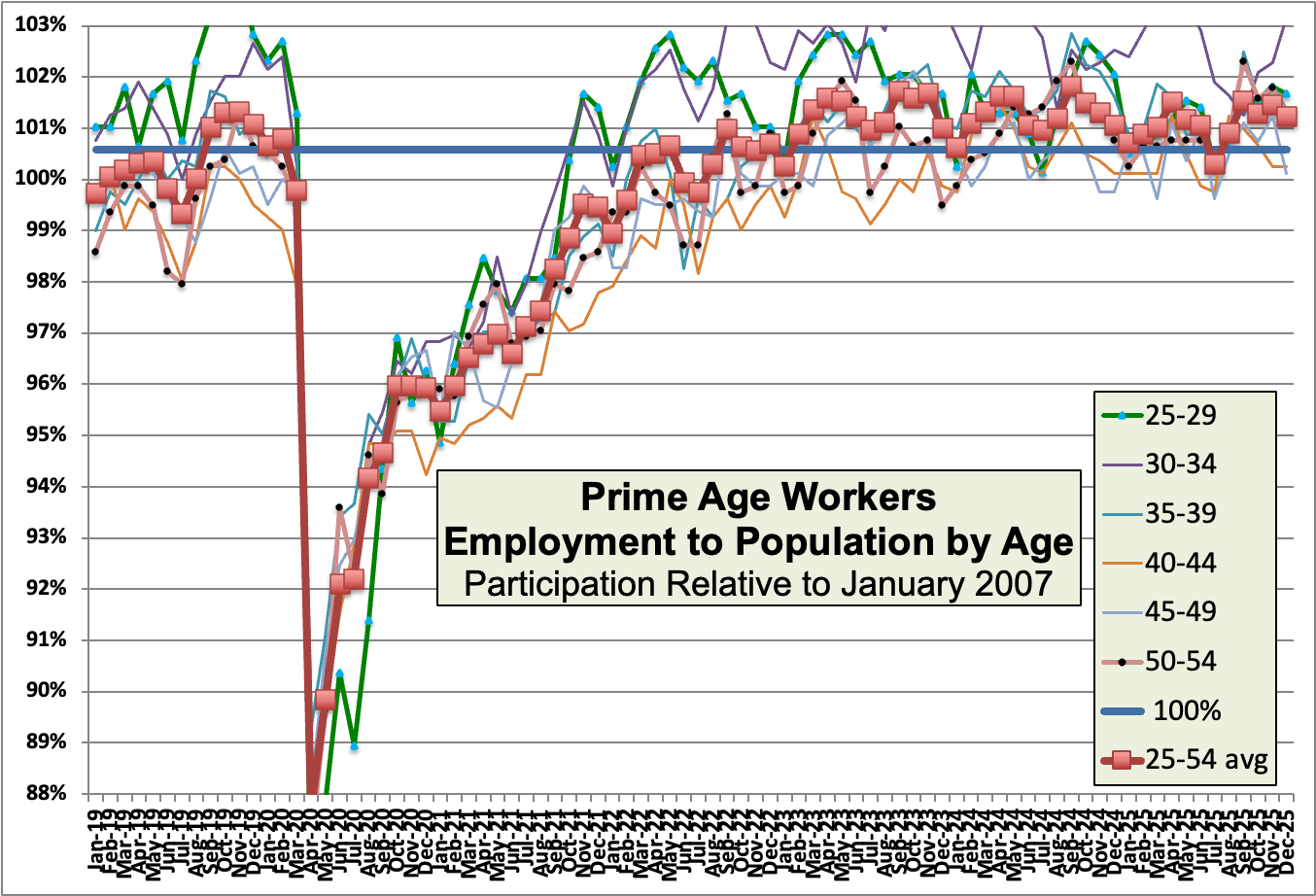
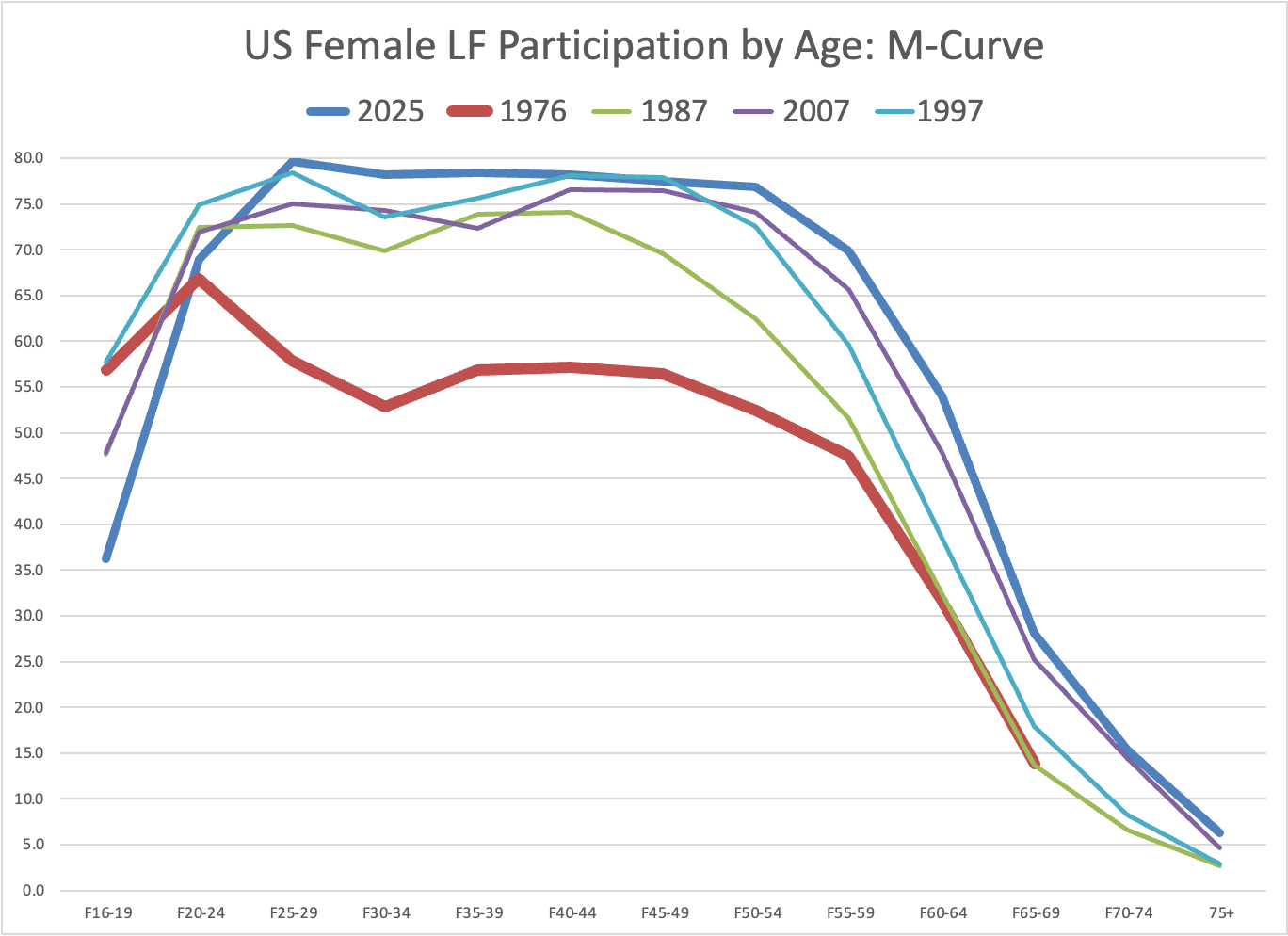
Now some of the Administration’s recent policy measures, such as the halt of health care subsidies to select states, will make it harder for women to work. The secular trend, however, indicates that stay-at-home moms are less important than in the past. Some of that is due to the challenges of maintaining a household with only a single earner. Some of it represents a tradeoff between work and family, reflected in lower fertility rates. In any case, the “M” pattern of female labor force participation is a thing of the past. Housewives may be the ideal of the proponents of “Project 2025” but that runs against a half century of evolution of the US labor market.
One implication locally is that businesses find it hard to expand. I’ve attended 2 iterations of a local housing symposium organized by my local Chamber of Commerce (for Rockbridge County and the cities of Lexington and Buena Vista). Construction costs are on the order of $215 a square foot, so even a modest 1,000 sq ft house will run over $200,000 for just the structure, and of course adding housing takes time. Howver, there are simply no vacant units of affordable housing for rent or purchase – realtors attending the session confirmed that. So one local expansion (Modine, a Wisconsin-based automotive HVAC manufacturer that is moving its non-auto commercial heating/cooling business headquarters here) has to poach people from other businesses, or convince new employees to commute across the Blue Ridge from Lynchburg, or from near West Virginia (as the local HR head does), or from along the I-81 corridor. Local labor force participation rates are already above the national average, so they can’t bring in people currently un(der)employed. A couple executives will be able to move to the area, but even though Modine pays above the “going rate” for staff, those wages won’t let someone purchase a $300,000+ house. So Modine must rob Peter – other regional businesses – to staff Paul.
So job creation may be low, but that’s a reflection of a fully employed labor force. Meanwhile, affordability remains an issue – it’s not that people don’t have jobs, it’s that the structure of the labor market means wages are too low to cover the cost of living, once childcare and housing and rising car insurance rates are included.1
In Rockbridge County, Virginia there’s only one fully-licensed daycare facility that will take an infant, and they only have 7 slots for a service area with a population of 35,000. Unless parents have an extended family or a neighbor who wants to watch children, then they need a stay-at-home parent, or a combination of day- and night-shift parents – my wife worked nights for several years – or some such. Of course such informal childcare fails if the (sole) caregiver comes down sick. My granddaughters are fortunate: all 4 grandparents are local and healthy and mostly in town, and so can pitch in to meet the school bus, cover school vacations and the like. During COVID, when both schools and daycare were shuttered, but the “kids” were full-time essential workers constantly exposed to COVID, my wife and I were full-time caregivers back to 2 am diaper changes. Hardly unusual, but it is indicative of the underlying challenges in the US context for a family with young children.